Algae is the most common, most frustrating, and most expensive recurring problem Houston pool owners face. It’s also the most preventable.
Every year, thousands of Houston homeowners spend hundreds of dollars on chemicals, emergency service calls, and days of downtime recovering from algae blooms that could have been avoided with the right knowledge and a consistent routine. The frustration isn’t just the cost. It’s the feeling that no matter what you do, the algae keeps coming back.
This guide exists to end that cycle. It covers everything a Houston pool owner needs to know about algae: what it is, why Houston’s climate makes it so aggressive, how to identify the different types, how to remove each one, and most importantly, how to prevent it from ever taking hold in the first place.
This isn’t generic national pool advice. Every recommendation in this guide is calibrated for Houston’s heat, humidity, UV intensity, hard water, organic debris load, and soil conditions. If you follow this guide consistently, your pool will stay clear.
Why Algae Is a Bigger Problem in Houston Than Almost Anywhere Else
Algae exists in every body of water on earth. Microscopic spores are constantly entering your pool through wind, rain, contaminated equipment, and even the swimsuits of people who swam in natural bodies of water. You can’t stop spores from entering the pool. What you can control is whether those spores find conditions favorable enough to multiply.
Houston provides those favorable conditions more consistently and more intensely than almost any other major metro area in the country.
The Perfect Storm: Heat, Sun, Humidity, and Nutrients
Algae needs three things to bloom: warmth, sunlight, and nutrients. Houston delivers all three in abundance.
Warmth. Houston pool water temperatures stay above 80 degrees Fahrenheit for five or more months of the year and regularly exceed 90 degrees in July and August. Algae growth rates roughly double with every 10-degree increase in water temperature above 60 degrees. At 90 degrees, algae reproduces at a rate that can turn a clear pool green in 24 to 48 hours if sanitizer levels drop.
Sunlight. Houston averages 8 to 10 hours of direct, intense sunlight during summer days, with UV index levels routinely hitting 10 or 11. This sunlight fuels algae’s photosynthesis, but it also destroys your primary defense against algae: chlorine. Unstabilized chlorine can lose up to 90 percent of its effectiveness within a few hours of direct Houston sun exposure.
Nutrients. Houston’s dense tree canopy sheds leaves, pollen, seeds, and bark into pools year-round. This organic matter decomposes and releases phosphates and nitrogen, the two nutrients algae feeds on most aggressively. Houston’s municipal water supply also contains low levels of phosphates and nitrogen that accumulate in pool water over time. Add fertilizer runoff from surrounding lawns after rain, and the nutrient load in a typical Houston pool is significantly higher than in pools located in desert or urban environments with less vegetation.
Houston’s Humidity Makes It Worse
Humidity doesn’t cause algae directly, but it creates conditions at the waterline and on pool surfaces that promote biological growth. The warm, moist microclimate above the water surface and along the tile line supports the formation of biofilm, a slimy layer of bacteria and algae that attaches to surfaces and serves as a nursery for more aggressive algae growth below the waterline.
This is why Houston pool owners often notice a slimy ring forming along the waterline tile, at the skimmer opening, and on ladder rails before a full-blown algae bloom appears in the water. That slime is the early warning system.
Types of Pool Algae in Houston
Not all algae is the same, and the treatment approach varies significantly depending on which type you’re dealing with. Houston pools encounter three primary types.
Green Algae
Green algae is by far the most common type in Houston pools. It’s the algae responsible for the classic “green pool” that Houston homeowners dread every summer.
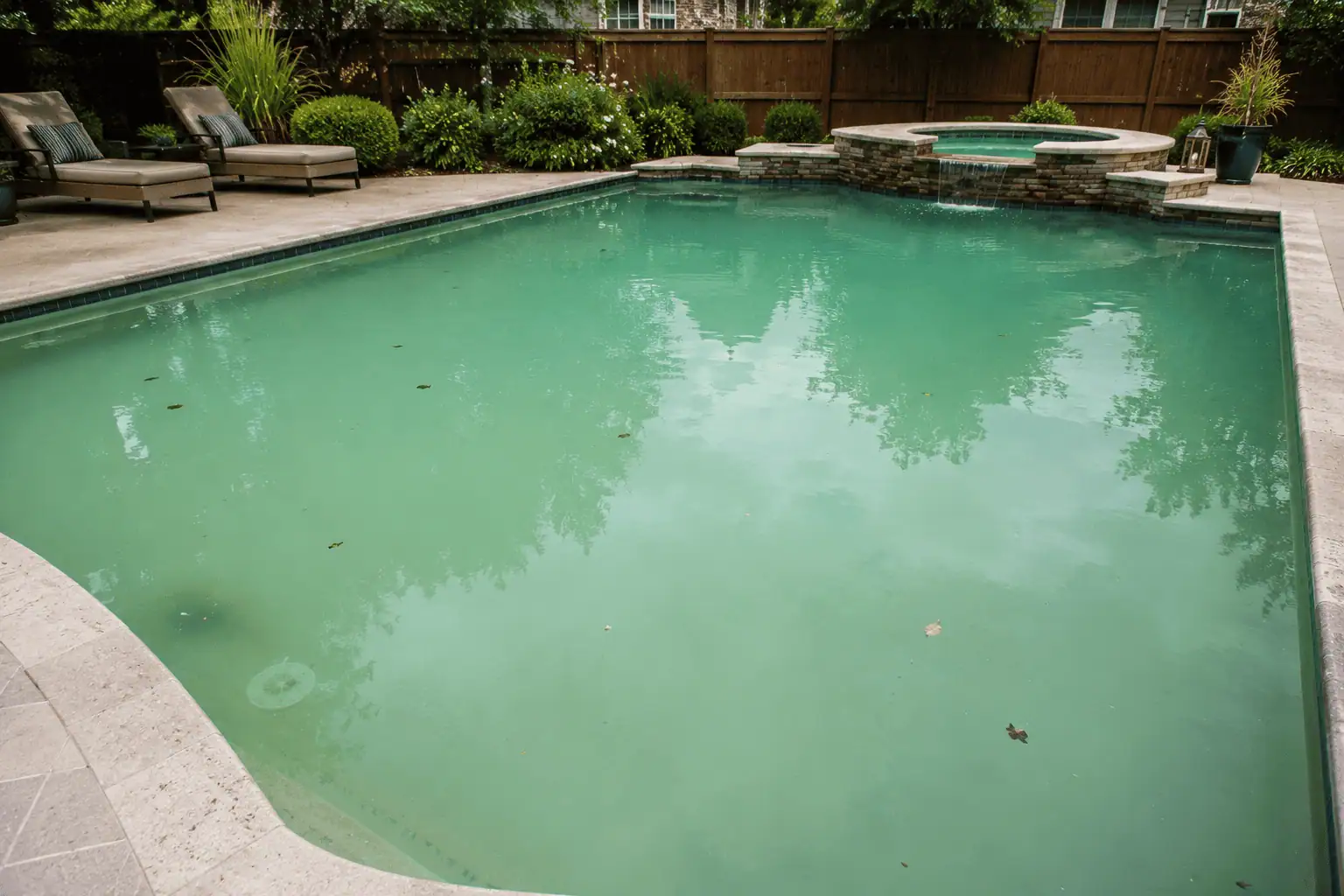
How to identify it: Green algae first appears as a slight haze or cloudiness in the water, especially noticeable when looking across the pool from the shallow end toward the deep end. As the bloom progresses, the water turns increasingly green, eventually reaching a dark, opaque green when the infestation is severe. Green algae also creates a slippery film on pool surfaces, walls, and steps.
Where it grows: Everywhere. Green algae is free-floating (suspended in the water) and surface-attached. It thrives in areas with poor circulation, including corners, behind ladders, along the floor in the deep end, and in any dead zones where water flow is minimal.
How fast it spreads: In Houston’s summer conditions, green algae can progress from invisible to fully green water in 24 to 72 hours once chlorine drops below effective levels. It is the fastest-growing algae type and the one most directly linked to lapses in chlorine maintenance.
Difficulty to treat: Moderate. Green algae responds to aggressive chlorine shock treatment and is the easiest type to eliminate completely. However, if treatment is incomplete, it rebounds quickly in Houston’s heat.
Yellow (Mustard) Algae
Yellow algae, commonly called mustard algae, is the second most common type in Houston and one of the most frustrating because it’s resistant to normal chlorine levels and notoriously difficult to eliminate permanently.
How to identify it: Yellow algae appears as a fine, powdery or sandy-looking deposit on pool walls, steps, and shaded surfaces. Its color ranges from pale yellow to brownish-gold. It’s often mistaken for pollen or sand, especially during Houston’s spring pollen season. The key distinction: pollen floats and can be skimmed off. Yellow algae clings to surfaces and returns after brushing within a day or two.
Where it grows: Yellow algae prefers shaded, low-circulation areas. You’ll typically find it on the shady side of the pool wall, on steps, behind ladders, on the pool floor near the main drain, and in any area that receives less direct sunlight. It can also colonize pool equipment, toys, floats, and cleaning tools, which is why recontamination is so common.
How fast it spreads: Slower than green algae. Yellow algae builds up gradually over days to weeks rather than appearing overnight. This gradual onset makes it easy to dismiss in the early stages, which allows it to establish firmly before homeowners take action.
Difficulty to treat: High. Yellow algae is chlorine-resistant at normal maintenance levels. It requires superchlorination (breakpoint chlorination at very high levels), a specific algaecide designed for yellow/mustard algae, and decontamination of every item that has touched the pool water. Incomplete treatment results in recurrence within days.
Black Algae
Black algae is technically not algae at all but a type of cyanobacterium. It is the most difficult pool contaminant to eliminate and the one that causes the most long-term surface damage.
How to identify it: Black algae appears as small, dark spots or clusters on pool surfaces, typically dark blue-green to black in color. The spots are small (often dime-sized or smaller) but firmly rooted. Unlike green algae, black algae has deep roots that penetrate into porous pool surfaces like plaster and concrete. It also has a protective outer layer that shields the organism from chlorine.
Where it grows: Black algae favors rough, porous surfaces. It’s most common on plaster, concrete, and unpainted surfaces. It tends to appear in areas with consistent sunlight exposure and can also grow on shaded rough surfaces. It is rare on tile, fiberglass, and smooth aggregate finishes because it needs surface porosity to anchor its root system.
How fast it spreads: Slowly. Black algae establishes over weeks to months. Individual spots may appear first, then gradually multiply if conditions remain favorable. Its slow spread makes it deceptive. A few spots seem minor, but each spot represents a deeply rooted colony that will continue to grow if not completely destroyed.
Difficulty to treat: Very high. Black algae’s protective outer layer must be physically broken through with aggressive brushing (stainless steel brush on plaster) before chemical treatment can reach the organism beneath. Standard shock treatment alone is ineffective. Even with proper treatment, if any root structure survives within the porous surface, the colony will regrow. Complete eradication of established black algae sometimes requires resurfacing the affected area.
The Complete Algae Prevention Strategy for Houston Pools
Removing algae is expensive, time-consuming, and frustrating. Preventing it is straightforward, low-cost, and far less disruptive. Every dollar spent on prevention saves five to ten dollars in treatment and recovery.
Here’s the complete prevention framework for Houston pools, organized by priority.
Priority 1: Maintain Chlorine Levels Without Exception
Free chlorine between 2 and 4 ppm is your primary defense. In Houston’s summer, target the higher end of that range (3 to 4 ppm) because heat and UV will push it downward between tests. Never let free chlorine drop below 1 ppm. Below 1 ppm, your pool has no effective sanitizer, and algae spores that are constantly entering the water can begin multiplying freely.
Test at least twice a week from June through September. A mid-week test takes 5 minutes and costs pennies. The cost of a green pool recovery starts at $100 and goes up from there.
Maintain cyanuric acid (stabilizer) between 30 and 50 ppm year-round. Stabilizer protects chlorine from UV degradation. Without it, Houston’s sun destroys chlorine faster than you can add it. With it, chlorine lasts 3 to 5 times longer in the water.
Priority 2: Run the Pump Long Enough
Circulation prevents dead zones where stagnant water allows localized chlorine depletion. Run your pump 10 to 12 hours per day during summer and 6 to 8 hours during the cooler months. The pump should turn over the entire pool volume at least once per day, and ideally 1.5 to 2 times per day during peak season.
If energy cost is a concern, a variable-speed pump running 12 hours at low speed uses less electricity than a single-speed pump running 6 hours at full power while providing far better circulation coverage.
Priority 3: Brush Weekly Without Exception
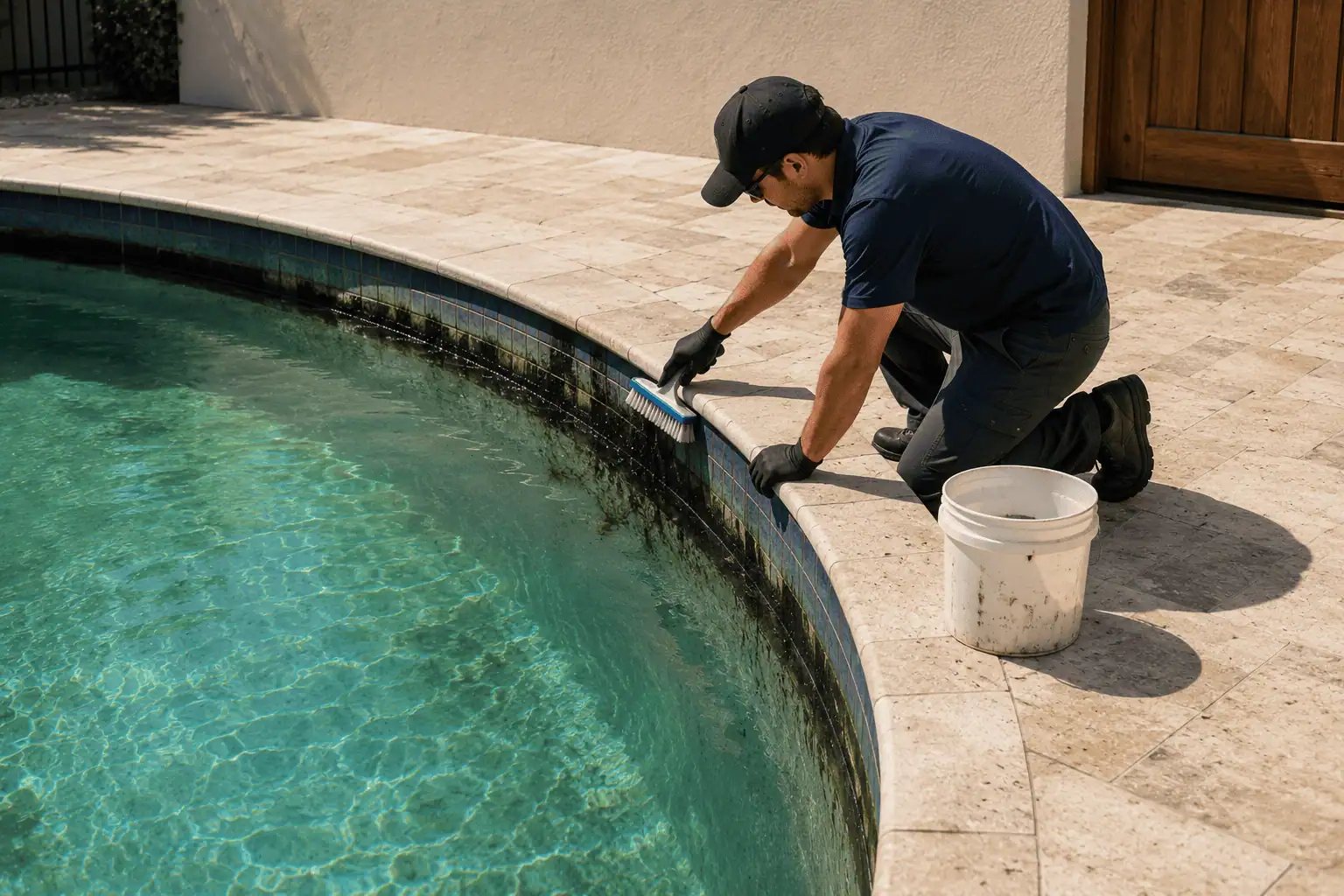
Algae begins as an invisible biofilm on surfaces. Brushing disrupts this biofilm before it matures into a visible bloom. Brush walls, steps, benches, corners, and the floor every single week, regardless of how clear the water looks. Pay special attention to shaded areas, behind ladders, and along the waterline where humidity promotes biofilm formation.
This is the most commonly skipped maintenance task, and it’s one of the most effective algae prevention measures available. Ten minutes of brushing per week prevents recovery events that consume days and hundreds of dollars.
Priority 4: Optimize Your Filtration
Your filter is the physical line of defense against algae spores that enter the pool. The finer your filtration, the fewer viable spores remain in the water to multiply when conditions become favorable.
Standard sand filters (20 to 40 micron filtration) allow the majority of algae spores to pass through and recirculate. Upgrading to volcanic ash filter media (2 to 5 micron filtration) captures spores that standard sand misses, dramatically reducing the algae population in the water at any given time. The media is permanent, never needs replacing, and eliminates the maintenance burden of cartridge cleaning or DE recharging.
For Houston pools with recurring algae problems despite proper chemistry, a filtration upgrade is often the missing piece that finally breaks the cycle.
Priority 5: Manage Phosphates
Phosphates are algae’s primary nutrient source. Houston pools accumulate phosphates from decaying leaves, pollen, fertilizer runoff, bird droppings, and the municipal water supply. Standard pool chemistry testing doesn’t always include phosphates, which is why many homeowners don’t realize they have elevated levels.
Test for phosphates at least quarterly. Levels above 300 ppb create conditions where algae can grow even in properly chlorinated water. If phosphates are elevated, apply a phosphate remover according to the manufacturer’s dosing instructions.
Reducing the organic load entering your pool is equally important. Regular skimming, keeping landscaping trimmed back from the pool edge, removing debris promptly, and managing sprinkler overspray all help keep phosphate levels manageable.
Priority 6: Shock Weekly During Swim Season
Weekly shock treatments oxidize organic contaminants, destroy chloramines (combined chlorine that has lost its sanitizing effectiveness), and provide a periodic chlorine boost that overwhelms any algae activity that may be developing below visible levels.
Shock after sunset so the chlorine has maximum working time before UV begins degrading it the next morning. Increase shock frequency after heavy rain, large pool parties, or any event that introduces a higher-than-normal contaminant load.
Priority 7: Don’t Skip Weeks
Consistency is the thread that runs through every prevention strategy. Every recommendation above works only if it’s performed consistently, week after week, throughout Houston’s extended swim season.
One missed week in July is enough for chlorine to drop, biofilm to establish, and the conditions for a bloom to take hold. Two consecutive missed weeks during peak summer virtually guarantees a green pool. The single most common cause of algae blooms in Houston is not a chemistry failure or an equipment problem. It’s a missed week of maintenance.
If maintaining weekly consistency is challenging, this is exactly the scenario where professional weekly pool service delivers its highest value. A professional technician doesn’t skip weeks, doesn’t take vacations from your pool, and maintains the consistency that algae prevention demands.
The Role of Pool Finish in Algae Susceptibility
Your pool surface finish directly affects how easily algae attaches and how difficult it is to remove.
Most susceptible: Rough, porous surfaces like deteriorating plaster and original Pebble Tec provide more attachment points for algae and allow black algae to root into the surface material. Older plaster that has etched, roughened, or developed calcium scaling is significantly more algae-prone than a smooth, new surface.
Moderately susceptible: Quartz aggregate finishes and newer pebble surfaces in good condition. The surface texture provides some attachment points, but the denser material resists penetration by black algae roots.
Least susceptible: Glass bead finishes, tile, and smooth fiberglass. These non-porous, smooth surfaces give algae very little to grip, making it easier to prevent attachment and easier to remove if algae does appear.
If your pool has recurring algae problems that persist despite proper chemistry and consistent maintenance, the condition of your surface finish may be a contributing factor. A deteriorating, porous plaster surface that’s 10 or more years old in Houston’s climate is significantly harder to keep algae-free than a fresh, properly applied finish.
Common Algae Treatment Mistakes to Avoid
Not Achieving Breakpoint Chlorination
The most common treatment failure is under-shocking. Adding a “normal” shock dose to a green pool doesn’t achieve breakpoint chlorination, the chlorine level (20 to 30 ppm) needed to overwhelm and kill established algae. The result is that the chlorine you added gets consumed by the algae without killing it, the pool stays green, and you’ve wasted chemicals. Always shock aggressively enough to reach breakpoint on the first attempt.
Shocking at High pH
Chlorine’s effectiveness drops dramatically as pH rises. At pH 7.0, chlorine is approximately 73 percent effective. At pH 7.6, it drops to about 50 percent. At pH 8.0, it’s roughly 22 percent effective. Always lower pH to 7.0 to 7.2 before shocking.
Not Brushing Before Treatment
Chemicals alone cannot penetrate the protective layers of yellow and black algae, or the biofilm layer of green algae on surfaces. Brushing physically disrupts these protective barriers and exposes the organisms to chemical treatment. Skipping the brush and relying on chemicals alone is the second most common reason algae treatment fails.
Turning Off the Pump During Treatment
Algae treatment requires continuous circulation to distribute chemicals evenly and push dead algae into the filter. Turning off the pump creates dead zones where algae survives the treatment and repopulates the pool once circulation resumes.
Not Cleaning the Filter During Recovery
Dead algae clogs filters rapidly. A filter that reaches maximum pressure and isn’t cleaned stops filtering, which means dead algae remains suspended in the water and the pool stays cloudy indefinitely. Clean the filter every 8 to 12 hours during active recovery.
Using the Wrong Algaecide for the Algae Type
Standard quaternary ammonia algaecides work for green algae prevention but are ineffective against yellow and black algae. Yellow algae requires sodium bromide-based or mustard algae-specific products. Black algae requires copper-based or polyquat algaecides. Using the wrong product wastes money and allows the algae to persist.
Frequently Asked Questions
What type of algae is most common in Houston pools?
Green algae is by far the most common. It’s responsible for the vast majority of “green pool” events Houston homeowners experience, especially during summer. Yellow (mustard) algae is the second most common, and black algae is the least common but most difficult to eliminate.
Can algae grow in a properly chlorinated Houston pool?
Under normal conditions, no. Maintaining free chlorine between 2 and 4 ppm with proper stabilizer levels (30 to 50 ppm cyanuric acid) prevents all three types of algae from establishing. However, if phosphate levels are extremely elevated (above 500 ppb), algae can gain a foothold even in chlorinated water. This is why phosphate testing and management are important supplements to chlorine maintenance.
Why does my pool keep turning green even though I add chlorine?
The three most common causes in Houston are: insufficient stabilizer allowing UV to destroy chlorine between additions, not running the pump long enough to circulate the chlorine throughout the pool, and not brushing surfaces to disrupt biofilm where algae is partially shielded from the chlorine in the water. If all three of those are addressed and the pool still turns green, test for phosphates and evaluate your filtration system.
How long does it take to clear a green pool in Houston?
A mild bloom (water hazy but floor still visible) typically clears in 2 to 3 days with proper treatment. A moderate bloom (green but partially translucent) takes 3 to 4 days. A severe bloom (opaque dark green) can take 5 to 7 days. Continuous pump operation and repeated filter cleaning throughout the recovery process are essential to these timelines.
Is black algae dangerous?
Black algae itself is not harmful to swimmers in the way that certain bacteria are. However, the rough, porous surface of black algae colonies can harbor harmful bacteria, including E. coli, within its protective layers. Additionally, black algae causes permanent staining and surface damage if not treated promptly. Pools with active black algae should not be used until treatment is complete.
Does salt water prevent algae?
No. Saltwater pools generate chlorine from dissolved salt, but the resulting chlorine works identically to traditionally added chlorine. A saltwater pool with low chlorine output will develop algae just as quickly as a traditional chlorine pool with low chlorine levels. The prevention strategies are the same for both systems.
When should I call a professional for algae treatment?
Call a professional if the water is dark green or black and the floor is not visible, if you’ve attempted treatment and the algae returned within a week, if you’re seeing yellow or black algae (both require specialized treatment protocols), or if your equipment isn’t functioning properly and can’t support the continuous pump operation required for recovery. Cabana Pools Aquatech provides professional algae treatment and pool recovery for Houston homeowners.
How much does professional algae treatment cost in Houston?
The cost of green pool recovery in Houston depends on the severity of the algae, pool size, type of algae present, and whether equipment repairs are needed before treatment can begin. Mild cases cost significantly less than pools that have been neglected for weeks. Yellow and black algae treatment runs higher due to the specialized products and multiple treatment rounds required. We provide a clear estimate after inspecting the pool in person. In nearly every case, the cost of consistent weekly pool maintenance is significantly less than repeated recovery treatments.
Keep Your Houston Pool Algae-Free, Permanently
Algae is persistent, but it’s predictable. It responds to the same conditions every time, and it’s prevented by the same strategies every time. In Houston, where the climate provides ideal algae growth conditions for the majority of the year, the difference between a pool that stays clear and a pool that battles algae all summer comes down to one word: consistency.
Consistent chlorine levels. Consistent pump run time. Consistent weekly brushing. Consistent filtration. Consistent maintenance, week after week, without gaps.
At Cabana Pools Aquatech, we’ve kept Houston pools algae-free for over 49 years. Every weekly service visit includes complete water chemistry testing and adjustment, thorough surface brushing, professional-grade filtration management, and equipment monitoring. We serve homeowners across Houston, Cypress, Bellaire, River Oaks, Memorial, Bunker Hill Village, Hedwig Village, the Energy Corridor, Tanglewood, Royal Oaks, Katy, Spring Branch, and surrounding communities.
We don’t offer biweekly service or chemical-only plans because they don’t work in Houston’s climate. We provide consistent, full-service weekly care that actually prevents algae rather than just reacting to it.
Contact Cabana Pools Aquatech for a free quote, or call us at (713) 467-3700 today.