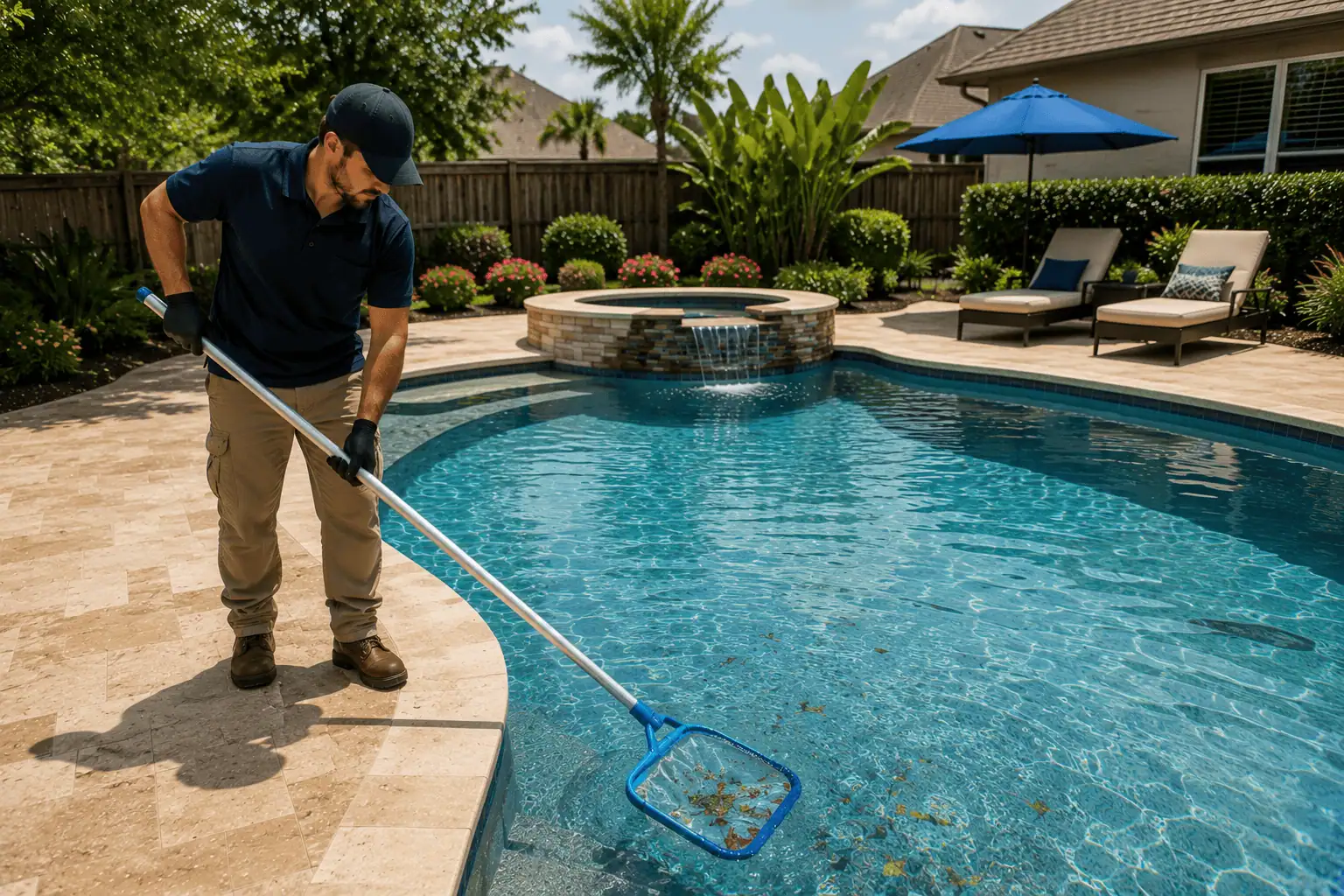
Pool care advice is everywhere. Friends share tips. Neighbors offer opinions. Social media is full of quick fixes and shortcuts. The problem is that a lot of this advice is either outdated or flat-out wrong, especially for Houston pools.
Houston’s heat, humidity, UV intensity, and heavy organic debris load create conditions that don’t follow the generic rules written for pools in milder climates. What works in Phoenix or Charlotte doesn’t always apply here.
These are the myths we hear most often from Houston homeowners, and the truth behind each one.
Myth 1: A Strong Chlorine Smell Means the Pool Is Clean
This is the most common myth in pool care, and it’s completely backward.
That strong “chlorine smell” at the pool isn’t free chlorine doing its job. It’s chloramines, which form when chlorine combines with sweat, sunscreen, body oils, and other organic contaminants in the water. Chloramines are a sign that your chlorine has been used up fighting contamination and is no longer actively sanitizing.
A properly cleaned and balanced pool has almost no smell at all. If your Houston pool smells strongly of chlorine, it actually needs more chlorine (a shock treatment) to break apart the chloramines and restore effective sanitation.
Myth 2: Clear Water Means Safe Water
Water can look perfectly clear and still be chemically unsafe to swim in. Clarity is a visual indicator, not a chemical one.
A pool with crystal-clear water can have dangerously low chlorine, a pH that’s irritating to skin and eyes, or elevated phosphate levels that are one hot day away from triggering an algae bloom. Houston’s intense UV can burn through chlorine so fast that a clear pool in the morning has zero sanitizer by afternoon.
The only way to know your water is safe is to test it. In Houston’s summer, that means testing at least twice a week, not just glancing at the water and assuming it’s fine.
Myth 3: You Only Need to Clean Your Pool in Summer
Houston isn’t Minnesota. There’s no true off-season here.
Pool water chemistry doesn’t stop shifting in winter. Algae can grow in Houston’s mild winters whenever water temperatures stay above 60 degrees, which is most of the time. Leaves and debris fall year-round, especially from live oaks and magnolias that never fully stop shedding.
And when cold fronts push overnight temperatures below freezing, your pump needs to run continuously to prevent pipe damage. Skipping maintenance during winter doesn’t save money. It creates problems you’ll pay for when spring arrives.
Weekly pool cleaning is a year-round commitment in Houston.
Myth 4: Running the Pump Less Saves Money
This one makes perfect logical sense, which is why so many Houston homeowners believe it. Less pump time equals less electricity, right?
Technically yes. But in Houston’s summer, cutting pump run time below 10 to 12 hours per day creates dead zones where chlorine depletes and algae takes hold. One green pool recovery costs far more in chemicals, time, and frustration than the electricity you saved.
The real money-saving move is upgrading to a variable-speed pump. A variable-speed pump running 12 hours at low speed uses less electricity than a single-speed pump running 6 hours at full power, while circulating more water and providing better filtration. You get better pool health and lower energy bills at the same time.
Myth 5: Biweekly Pool Cleaning Is Enough
Some pool companies offer every-other-week service at a lower monthly rate. It sounds like a smart way to save. In Houston, it’s a recipe for constant problems.
A Houston pool that goes two weeks without service during summer will experience chlorine depletion, debris buildup, rising phosphate levels, and filter strain. By the time the biweekly technician arrives, they’re not performing routine maintenance. They’re performing recovery.
The chemicals needed to correct two weeks of drift cost nearly as much as two weekly visits. Add in the occasional green pool event and the accelerated wear on equipment, and biweekly service ends up costing more than weekly in total annual spending.
Cabana Pools Aquatech doesn’t offer biweekly service because decades of Houston experience have shown us it doesn’t work in this climate.
Myth 6: If You Add Enough Chemicals, You Don’t Need to Brush
Chemicals kill algae in the water. They don’t kill algae attached to surfaces.
Algae starts as an invisible biofilm that clings to pool walls, steps, corners, and the waterline. This biofilm develops a protective layer that chlorine in the water can’t fully penetrate. The algae sits on the surface, partially shielded, growing quietly until it reaches a critical mass and the pool turns green.
Brushing disrupts that biofilm and suspends the algae in the water where chemicals can actually reach it. Ten minutes of brushing per week prevents recovery events that consume days and bags of shock. No amount of chemical treatment replaces the brush.
Myth 7: Saltwater Pools Don’t Need Maintenance
This myth has convinced a lot of Houston homeowners that a saltwater conversion means freedom from pool care. It doesn’t.
A saltwater system generates chlorine from dissolved salt using a salt chlorine generator. The chlorine it produces works identically to traditionally added chlorine. If the generator isn’t producing enough, or if the salt cell is dirty, or if Houston’s UV and heat are consuming chlorine faster than the cell can make it, you get the same algae, the same cloudy water, and the same problems as a traditional chlorine pool.
Saltwater pools still need weekly chemistry testing, brushing, skimming, filter maintenance, and equipment monitoring. The salt cell itself needs periodic cleaning and eventual replacement. Saltwater is also slightly more corrosive to certain pool materials, which makes consistent professional maintenance even more important.
Myth 8: Anyone Can Handle Pool Electrical Repairs
When a pump stops working or a light goes out, some homeowners call whoever can get there fastest and cheapest. In many cases, that means an unlicensed handyman or a pool company using unlicensed workers for electrical tasks.
Texas state law requires that all electrical pool repairs be performed by licensed technicians. This isn’t just a rule. It’s a safety issue. Pool electrical systems operate near water, and improper wiring, grounding, or bonding creates real electrocution hazards.
Beyond safety, unlicensed electrical work voids manufacturer warranties, creates code violations, and can result in denied insurance claims if something goes wrong. At Cabana Pools Aquatech, licensed electricians handle every electrical repair. No exceptions.
Stop Following Myths. Start Following What Works.
Houston pools don’t forgive shortcuts. The heat is too intense, the algae is too aggressive, and the margin between a clean pool and an expensive problem is too narrow for guesswork.
At Cabana Pools Aquatech, every service decision is based on 50 years of real-world Houston experience, not internet advice, not shortcuts, not myths. We provide full-service weekly pool cleaning that includes everything your Houston pool actually needs: proper chemistry, thorough brushing, professional filtration, and equipment monitoring.
Contact Cabana Pools Aquatech for a free quote, or call us at (713) 467-3700 today.