If you’re thinking about hiring a pool service in Houston, one of the first questions you’ll run into is simple: what am I actually paying for?
The answer depends entirely on the company. Some pool services offer full-service visits that cover everything your pool needs. Others offer chemical-only visits where a technician tests the water, adds chemicals, and leaves. The difference between the two is significant, and in Houston’s climate, the gap between them is the gap between a pool that stays clean and one that constantly battles problems.
Here’s what a proper full-service weekly pool visit should include, what it shouldn’t include, and why the distinction matters.
Water Chemistry Testing and Balancing
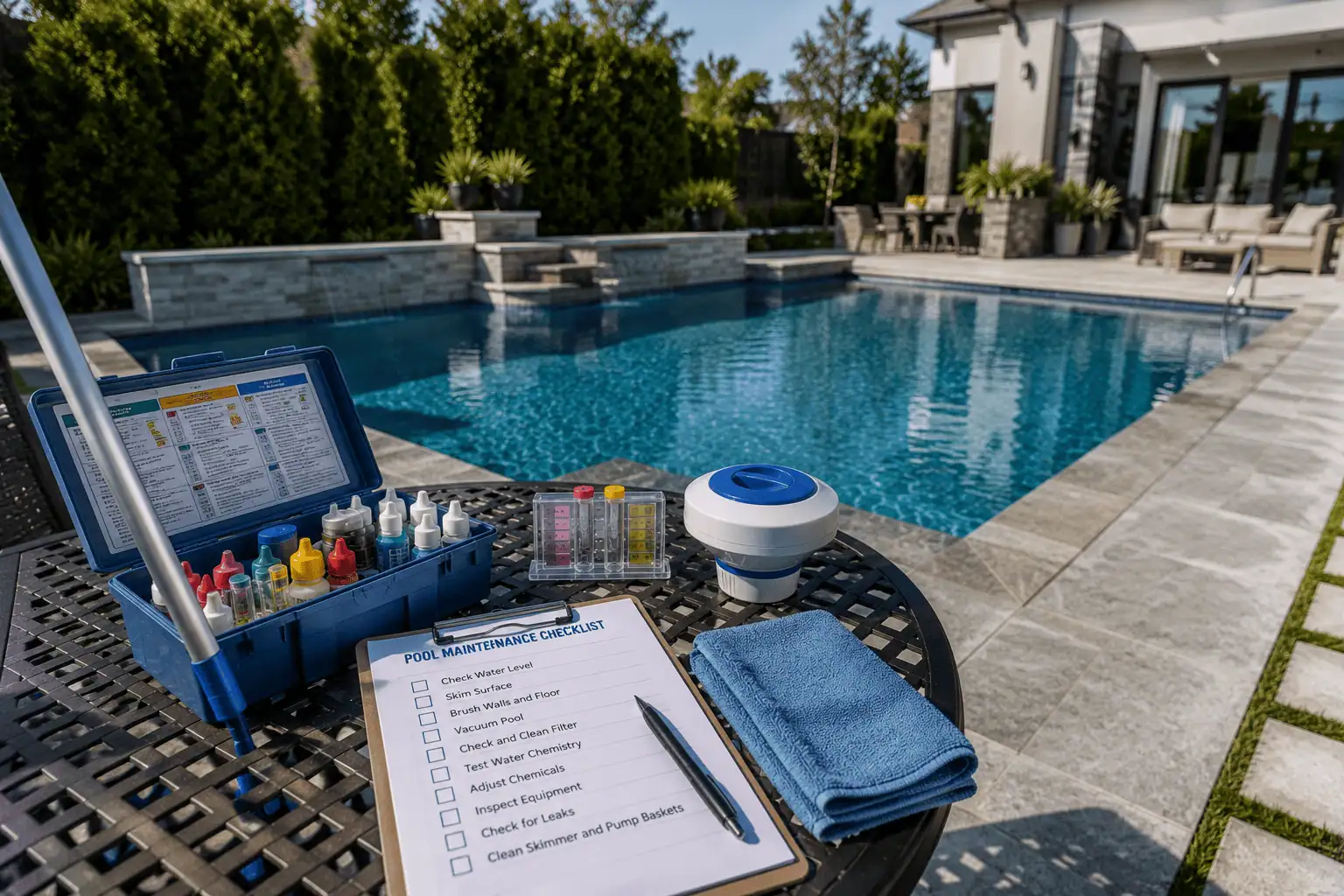
This is the foundation of every visit. Your technician tests the water and adjusts chemicals to keep everything within safe, optimal ranges.
The key readings checked each week:
- Free chlorine (your primary sanitizer, kept between 2 and 4 ppm)
- pH (kept between 7.4 and 7.6 for swimmer comfort and chlorine effectiveness)
- Total alkalinity (kept between 80 and 120 ppm to buffer pH from swinging)
- Cyanuric acid/stabilizer (kept between 30 and 50 ppm to protect chlorine from Houston’s UV)
- Calcium hardness (monitored closely because Houston’s hard water pushes it upward over time)
Your technician doesn’t just check whether numbers are in range. They watch for trends. A pH that’s slowly creeping upward, a chlorine level that’s holding but barely, or a calcium reading that’s approaching the limit. Catching a trend early avoids the chemistry crash that happens when a number finally breaks out of range.
Shock treatments are applied as needed based on water conditions rather than on a fixed schedule. After heavy use, storms, or when chloramine levels are elevated, your technician will shock the pool to oxidize contaminants and restore effective sanitation.
Surface Care: Skimming, Vacuuming, and Brushing
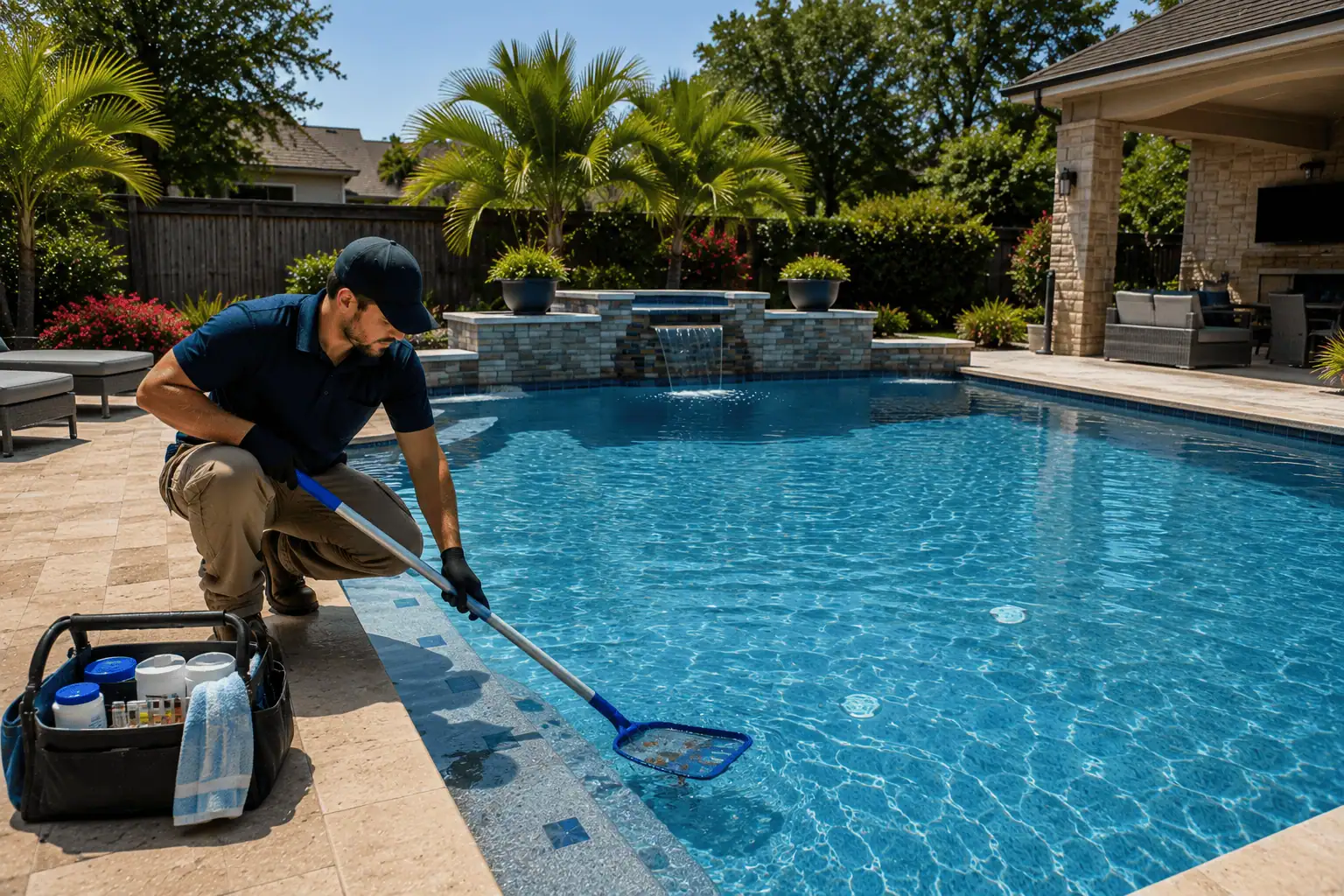
This is the part of the visit you can see. It’s also the part that separates full-service cleaning from chemical-only service.
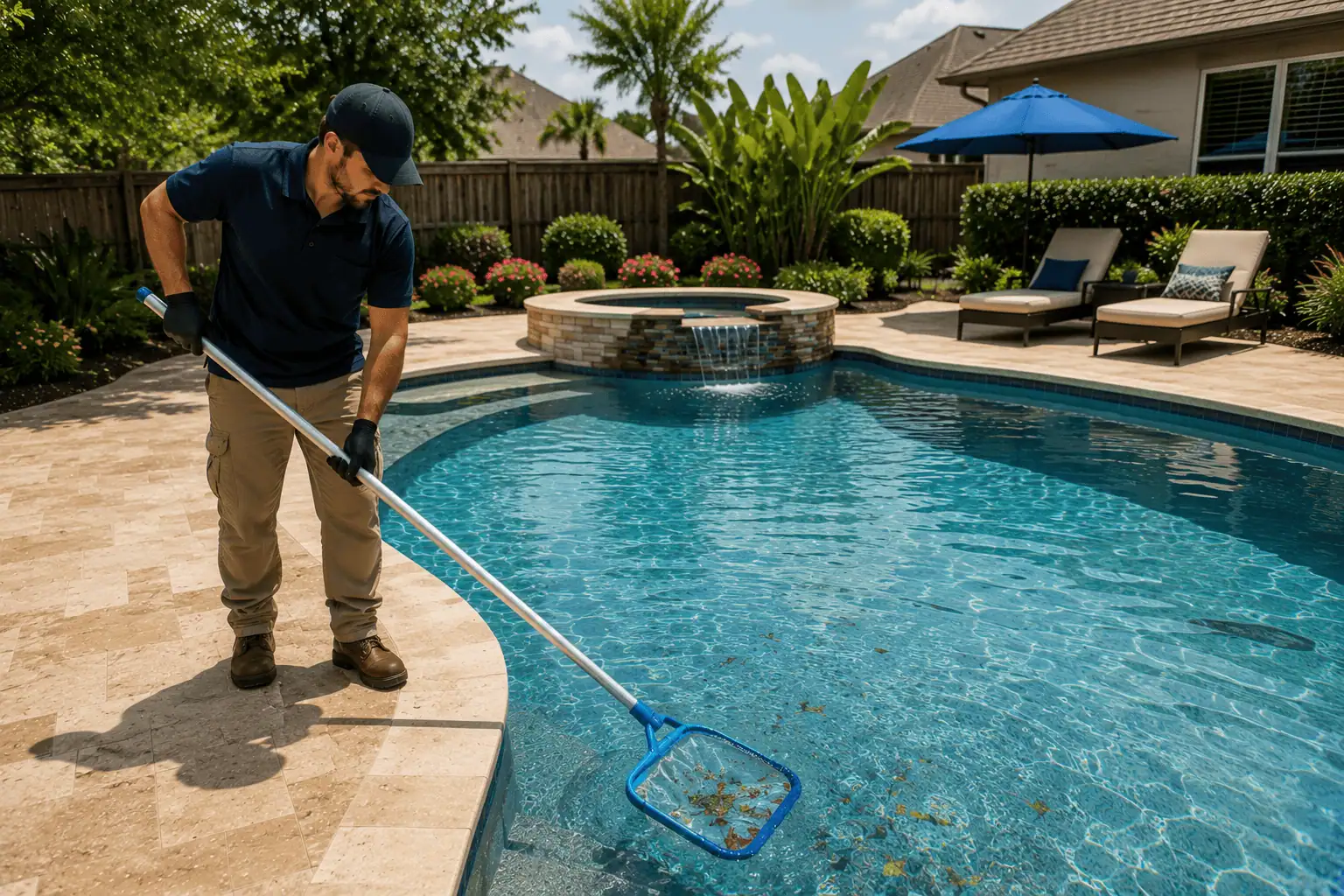
Skimming removes everything floating on the surface: leaves, pollen, insects, and debris. In neighborhoods like Bellaire with heavy tree coverage, the skimmer basket can fill within days. Removing this debris before it sinks and decomposes prevents phosphate buildup that feeds algae.
Vacuuming picks up particles that have settled on the pool floor. Dirt, fine debris, and dead algae all end up on the bottom. Left there, they cloud the water and increase chemical demand. A full vacuum of the pool floor is part of every visit.
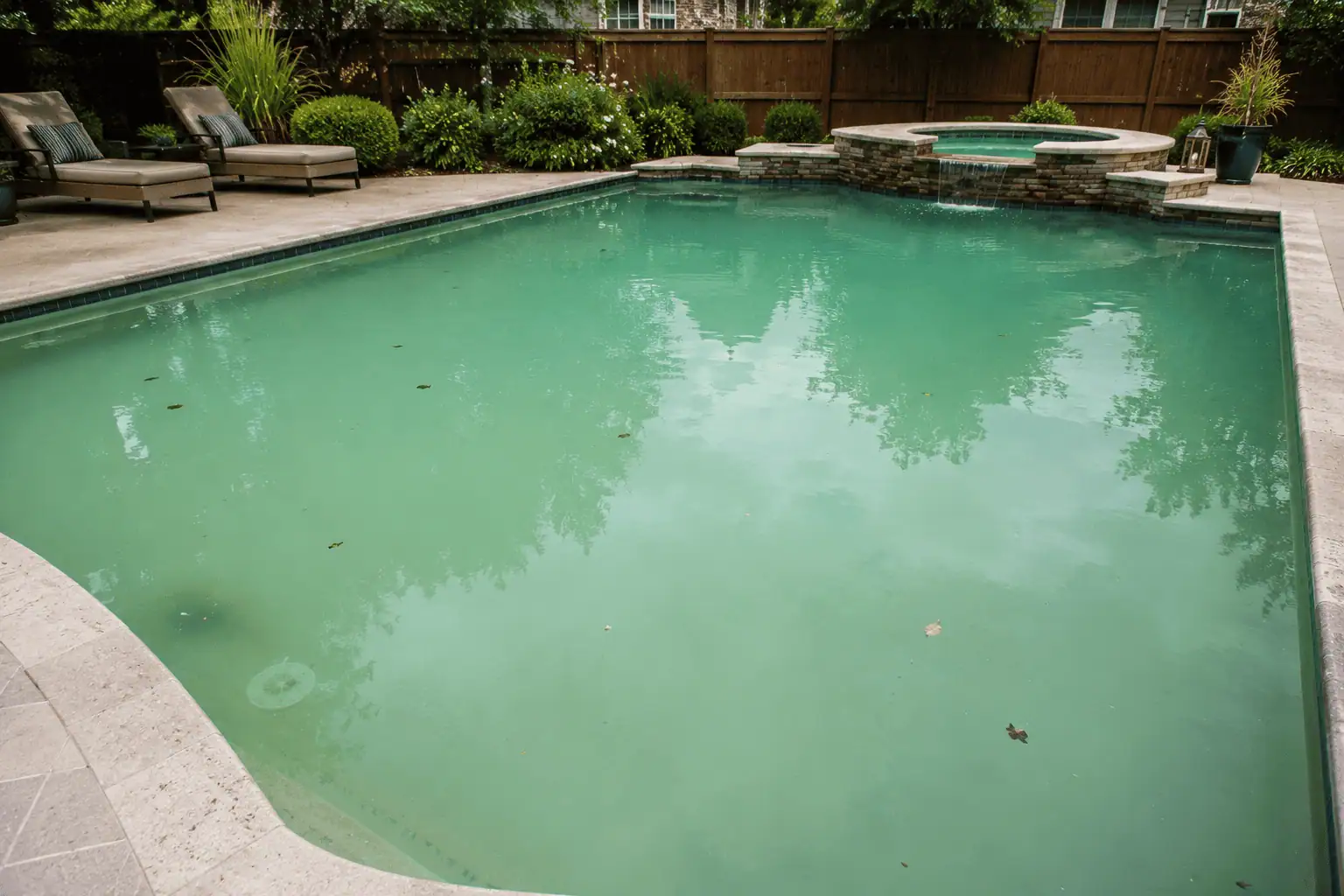
Brushing is the most underrated step in pool care. Algae doesn’t start as green water. It starts as an invisible biofilm on walls, steps, corners, and the waterline. This biofilm is partially shielded from chlorine because it clings to the surface. Brushing disrupts it and suspends the algae in the water where chemicals can actually kill it.
If your pool service doesn’t brush every visit, they’re leaving the door open for algae to establish. In Houston’s heat and humidity, that door doesn’t stay open long before something walks through it.
Filtration and Basket Care
Your filter only works if it’s maintained. Your pump only runs efficiently if the baskets are clear.
Skimmer basket and pump basket emptying happens at every visit. A full basket restricts water flow, reduces filtration, and puts unnecessary strain on the pump. In Houston’s heavy-debris environment, baskets can fill up fast between visits, so they’re always checked and emptied.
Filter pressure monitoring tells the technician whether the filter is operating within its normal range. When pressure rises above the clean baseline, the filter needs backwashing or cleaning. When pressure won’t rise (stays abnormally low), it may signal a pump issue that needs further investigation.
For Houston pools, Cabana Pools Aquatech recommends volcanic ash filter media, which filters down to 2 to 5 microns compared to standard sand at 20 to 40 microns. It catches fine pollen, organic particles, and algae spores that conventional sand misses. The media is permanent and never needs replacing, which eliminates ongoing filter maintenance costs.
Equipment Monitoring
A good weekly service includes a basic equipment check at every visit. Your technician isn’t doing a full mechanical teardown, but they are paying attention.
They listen for unusual pump sounds that signal bearing wear or motor issues. They check for visible leaks at unions and fittings. They confirm the heater is cycling correctly. They verify that the automation system is running its schedules. If anything looks or sounds off, they flag it before it becomes an emergency.
This ongoing monitoring is one of the biggest advantages of professional pool service. A technician who sees your equipment every week develops a baseline understanding of what normal looks and sounds like. When something changes, they notice. Small problems get caught at the stage where a minor repair fixes them, not at the stage where a full replacement is the only option.
All electrical pool work, including pump motor replacement, heater service, and automation troubleshooting, must be performed by licensed technicians as required by Texas state law. At Cabana Pools Aquatech, licensed electricians handle every electrical task.
What’s NOT Included in Weekly Service
Weekly pool cleaning is maintenance, not renovation. Here’s what falls outside the weekly scope and is quoted as separate work:
- Major equipment repairs or replacements (pump, heater, salt cell)
- Pool resurfacing or replastering
- Deck repair or resurfacing
- Plumbing leak detection and repair
- Structural crack repair from clay soil movement
- Water feature installation or modification
A good pool company identifies developing issues during weekly visits and provides repair quotes before something becomes an emergency. The weekly visit is also the weekly inspection, which is one of its most valuable hidden benefits.
Full-Service vs. Chemical-Only: Why It Matters
Not every pool company means the same thing when they say “weekly pool service.” Some companies offer chemical-only visits: the technician tests the water, adds chemicals, and leaves. No skimming. No vacuuming. No brushing. No basket cleaning. No equipment check.
Chemical-only service might keep your chlorine in range, but it leaves the pool visually dirty, allows algae biofilm to build on unbrushed surfaces, lets debris decompose and feed phosphates, and provides zero oversight on your equipment.
In Houston’s climate, chemical-only service is not enough. The organic debris load is too heavy, the algae pressure is too constant, and the equipment runs too hard for a visit that only addresses chemistry.
When comparing pool companies, always confirm what’s included. The monthly number only matters if the scope behind it covers everything your Houston pool actually needs.
Every Visit, Everything Your Pool Needs
Weekly pool service should feel simple from your perspective. The technician comes, does the work, and your pool is clean, balanced, and ready to use. You shouldn’t have to think about it.
At Cabana Pools Aquatech, that’s exactly how it works. Every weekly visit covers complete water chemistry, full surface care, filtration maintenance, and equipment monitoring. We’ve been providing this level of service across Houston, Cypress, Bellaire, Memorial, the Energy Corridor, Katy, and surrounding communities since 1976.
No chemical-only shortcuts. No biweekly schedules. Just reliable, full-service care every single week.
Contact Cabana Pools Aquatech for a free quote, or call us at (713) 467-3700 today.